
Anchored block slope stabilisation is used to improve the stability of slopes, repair damaged retaining walls, and control landslide movement using anchored reinforced concrete reaction blocks.
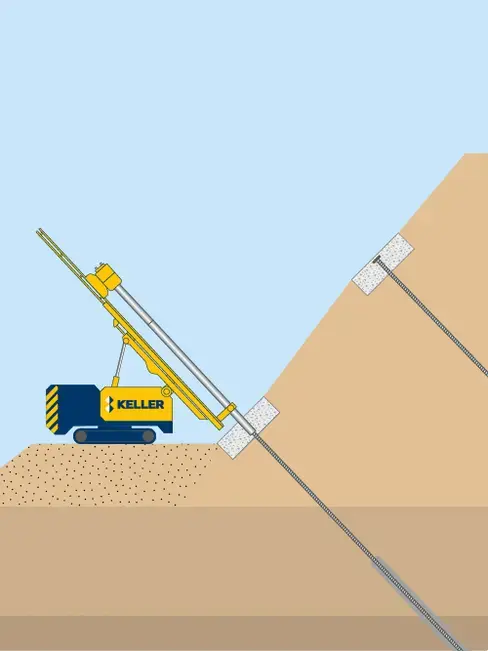
Process
Anchored block slope stabilisation consists of discrete, anchored reinforced concrete blocks placed in a pattern on a slope to increase slope stability.
The block layout pattern is typically in rows across the slope or retaining wall. A stable borehole is drilled to the designed diameter and length; the anchor (strand or bar with free and bond lengths) is installed, and the anchor is then grouted in place. Reaction blocks are either precast or cast-in-place around the anchor heads. Bearing plates are installed, and the anchors are tensioned against the blocks. The finished anchored reaction blocks resist the movement of the retained soil or wall.
Common uses
- Temporary or permanent slope stabilisation
- Repair of damaged or failing retaining walls
Advantages
- Cost-saving solution for landslide repair and slope stability control compared to traditional methods
- Can be designed for permanent or temporary support
- Crane-mounted equipment can be used in difficult access slopes
Quality assurance
Keller has been installing anchors for many years, continually evolving the technique to achieve better performance. Testing and monitoring ensure high-quality execution.