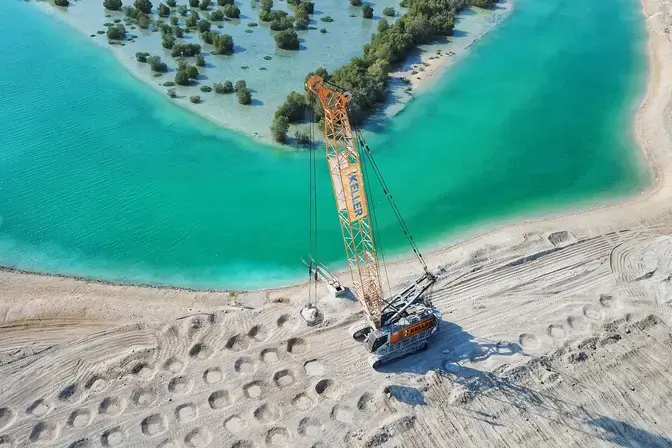
This technique involves construction of loadbearing columns made from gravel or crushed stones that can share the load with the surrounding soil.
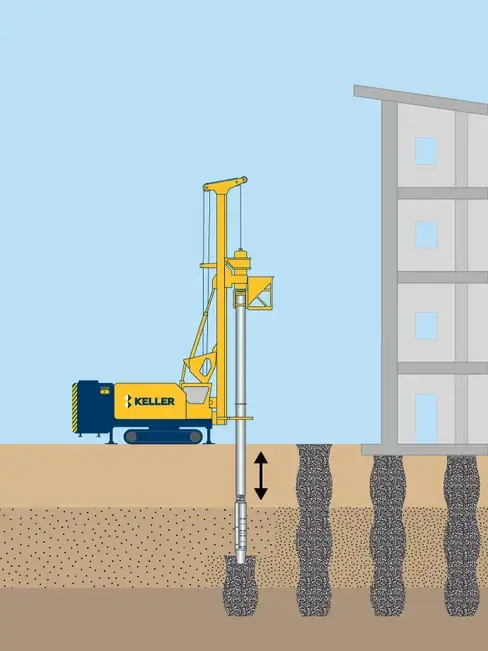
Process
This technique emerged in 1957 when reinforcement of weak cohesive soils and mixed soils by means of stone columns was made possible using the Keller-made vibrator. By water jetting, the fines are flushed out and the liquefied annulus around the vibrator allows the coarse aggregate to sink in. By surging and electronic monitoring a well compacted stone column is constructed. The vibro-replacement process is now a well-established solution for soil replacement to large depths as it is cheaper and faster than the conventional methods that involve, dewatering, excavation and layer-wise compaction.
Wet top-feed method
In the wet top-feed process, the vibrator penetrates to the design depth using the vibrator’s weight and vibrations, as well as water jets located in the tip. The stone (crushed stone or recycled concrete) is then added at ground level to the space around the vibrator created by the jetting water. The stone falls through the space to the vibrator tip, and fills the void created as the vibrator is lifted a few hundred millimetres. The vibrator is then lowered, densifying and displacing the underlying stone. This vibro replacement process is repeated in lifts until a dense stone column is constructed to the ground surface.
Dry bottom-feed method
The dry bottom-feed process is similar, except that no water jets are used and the stone is fed to the vibrator tip through an attached feed pipe. Pre-drilling of dense strata may be required for the vibrator to penetrate to the design depth.
Vibro rigs can be fully instrumented with an on-board data acquisition system. Data from the system, such as amperage and lift rate, can then be recorded and displayed in real-time alongside specified target values on an in-cab monitor. This monitoring allows the operator to correct any deviations in real-time during the construction process to keep the vibro compaction within project specifications.
Variations on the product include vibro concrete columns where concrete is pumped into the ground through the vibrator, and grouted stone columns where the aggregate is mixed with a cement based grout on installation.
Common uses
- Reduce foundation settlement
- Increase bearing capacity, allowing reduction in footing size
- Increase stiffness
- Increase shear strength
- Reduce permeability
- Mitigate liquefaction potential
- Prevent earthquake-induced lateral spreading
- Provide slope stability
Advantages
- A versatile ground-improvement method than can be adjusted to a wide variety of soil conditions and foundation requirements
- Offers an economical solution for ground improvement
- Can be carried out to almost any depth
- Relatively quick execution so subsequent structural works can follow very quickly
- Soil improvement enables standard shallow footings which can lead to savings
- Environmentally-friendly as uses natural and in situ materials
- Extremely quiet with low vibration
- Only a small quantity soil has to be removed during the process so avoids the cost of spoil removal associated with continuous flight auger and bored piling systems
Quality assurance
The vibro equipment we use is designed and manufactured by our in-house equipment manufacturer exclusively for use by Keller companies.
In-house quality production manager software enables us to capture and analyse data in real time and valid the performance of the ground improvement being carried out.
A variety of production parameters are generally logged during execution including depth, current, pull down force, uplift/pull down sequence, time and date and element number.
Field trials can also be used to verify column production parameters, along with static load tests, single or group, column material compressive strength tests, and column diameter verification.

Related projects
Infrastructure
Salwa 380KV BSP Substation
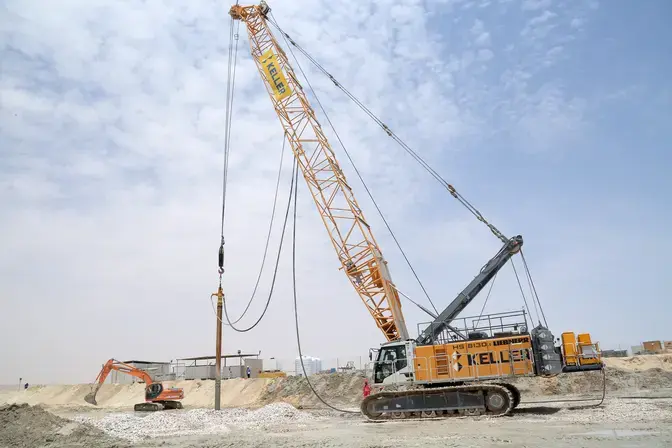
Keller successfully delivered a design-and-build solution for the BSP 380 kV Substation using large-diameter Vibro-stone columns, achieving the required bearing capacity, controlling settlements, and enabling an optimized reinforced concrete foundation design while mitigating liquefaction risks under seismic loading.
Energy and utilities
Synchronous Condensers Facilities
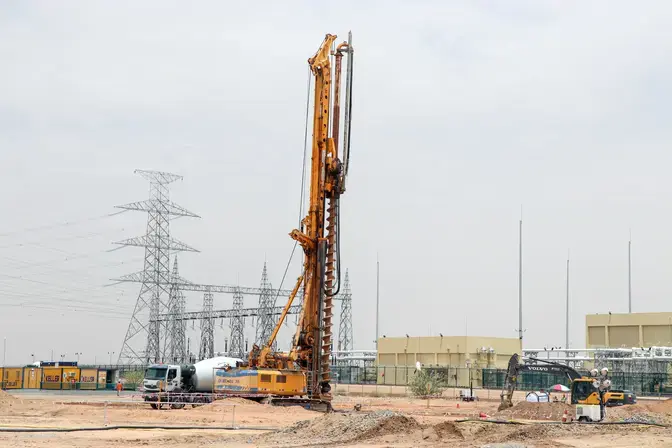
A performance-based ground improvement solution was developed to enhance foundation support and mitigate liquefaction risks, supported by rigorous testing to validate compliance with project design criteria for the two SC facilities sites.
Energy and utilities
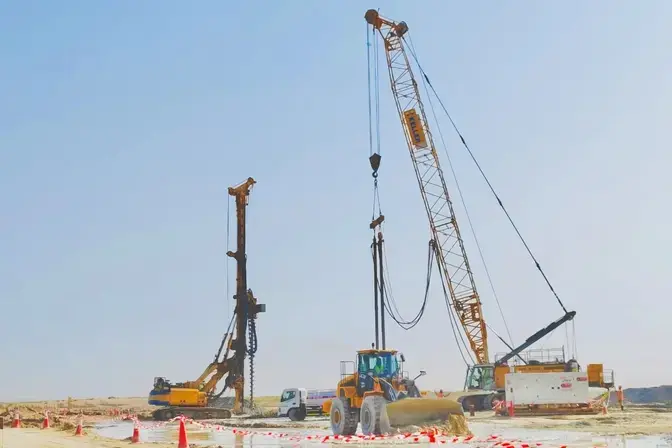
Hassyan 180 MIGD SWRO IWP- Probing
Challenging project due to its complex stratigraphy of intermittent hard and soft layers and presence of cavities in rock strata. Multiple ground improvement techniques like probing, cavity grouting and vibro replacement were required.
Industrial
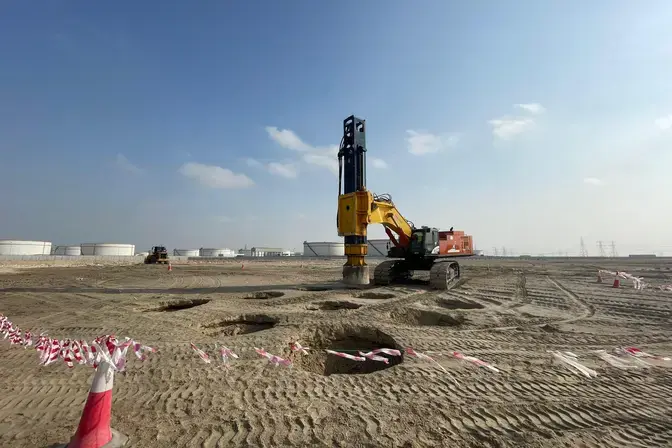
KEZAD Gate Warehouses
Ground improvement works using Rapid Impact Compaction, Dynamic Compaction, Dynamic Replacement, and Vibro Replacement techniques for warehouses.
Residential
Jubail Island
Ground Improvement for heterogynous soil profile by applying different ground improvement techniques.