
Bored piles are a very effective, state-of-the-art construction element with many applications in foundation and civil engineering. Temporary and permeant steel casings are used for a number of engineering reasons.
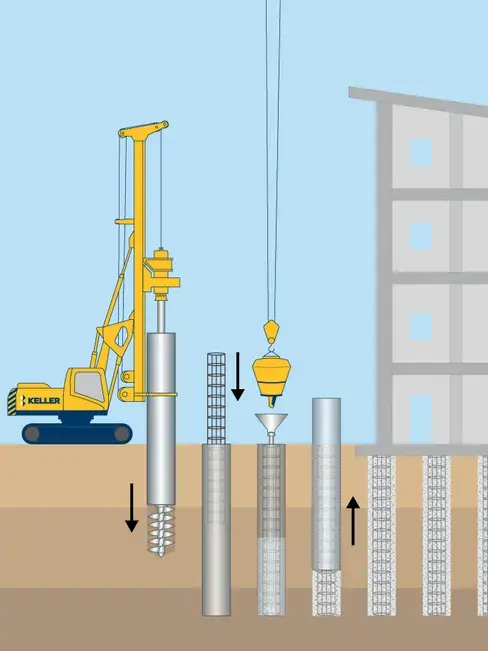
Process
A casing is installed by rotation, oscillation or vibration, soil drilled out using specialised tools, and additional lengths of casing(s) jointed and installed to a predetermined depth. Full length reinforcing steel is then lowered into the hole which is then filled with concrete. Temporary casings are then recovered.
Common uses
- Ensuring critical verticality tolerances are achieved to protect existing buildings or underground structures
- To achieve adequate pile overlap at depth when installing an interlocking (secant) pile wall
- Where greater lateral and shear capacity are needed for slope stabilisation or prevention of landslides
- To bypass pile loads into unsuitable strata and avoid negative skin friction
- To temporarily support an open bore at depth
- To facilitate pile cut off levels above working platform level
Advantages
- Can support high loads
- Can transfer loads
- Can achieve strict tolerances for verticality
- Various diameters available from 450mm upwards
- Minimal settlement and deformation
- Minimum vibration
Quality assurance
[Company] uses a variety of quality assurance methods for our products including top down and integrity testing, bottom bi-directional pile load tests, and digital recording and logging of the execution parameters.
A range of digital and physical tools including inclinometers, guide walls and GPS equipped total stations can be used to assure plan position and verticality.