
Keller installs either tremie seals or soil mixing underneath water basements and structures. We cater to the most cost-effective alternative for our clients.
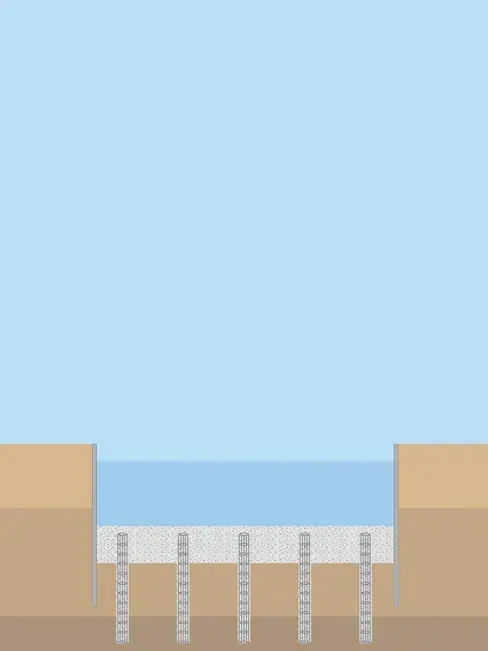
Process
Bottom seals have been used for centuries. Some of the earliest tremie seals have been discovered under Roman bridges. With a long history of efficiency, a tremie seal aids an excavation to minimise water intrusion. When excavating deep, along a shoreline, close to a river, nearby a body of water, or below a water table, dewatering the site/excavation can be challenging. A tremie seal is a non-reinforced concrete slab anchored by piles against buoyancy and installed underwater by divers within sheet piling or slurry walls to control water intrusion.
The perimeter sheet piling is installed, followed by anchored production piles. The tremie is poured, and the excavation can be dewatered when the concrete slab gets hard enough.
Common uses
- Temporarily lower groundwater levels to allow dry excavations
- Control groundwater inflow to excavations and underground structures
- Reduce pore water pressures and improve soil stability
- Enable construction in wet or water-bearing soils
- Support tunneling, shaft construction, dam rehabilitation, and environmental remediation
Advantages
- Long history of efficiency
- Minimises water intrusion